

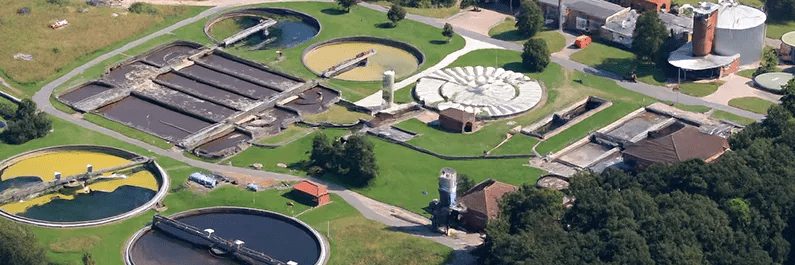
In the context of climate change, cities and municipalities must ensure their facilities and processes operate as efficiently and sustainably as possible. The municipal authority Stadtentwässerung Celle identified significant potential for optimization at its wastewater treatment plant (WWTP), enabling a collaborative initiative to reduce energy consumption and chemical use.
The challenge
Stadtentwässerung Celle is the city of Celle’s municipal wastewater authority which operates a municipal wastewater treatment plant with a design capacity of 120,000 population equivalents (PE).
As a modern, climate-aware city, Celle’s aim was to optimize energy consumption in the pressurized aeration system of the plant’s biological treatment stage, enhance operational reliability and process stability, and implement predictive control of chemical dosing. The goal was to deploy an intelligent system to streamline process workflows, thereby reducing operating costs, while consistently complying with effluent discharge limits.
In addition, these smart systems can also considerably reduce CO₂ emissions, thus enabling Stadtentwässerung Celle to make a significant contribution to environmental and climate protection.
The solution
The project began in mid-2017 with the development of a real-time decision-support system for wastewater treatment processes.
Stadtentwässerung Celle was already using conventional sensor technology and automation systems for process control, but it lacked an integrated optimization strategy.
The objective was to improve the efficiency of the aeration process in the biological treatment stage through real-time simulation. This approach aimed to reduce energy and chemical consumption while simultaneously enhancing effluent quality.
In collaboration with Xylem, the Xylem Vue WWTP optimization technology was implemented and has since been integrated as a module into Xylem Vue Plant Management. The Xylem Vue wastewater treatment plant optimization solution uses models for the conversion of carbon, ammonium and nitrate, based on high-performance neural networks.
The system receives the required data for this in real time from the plant’s existing PLC system. Using a previously developed digital twin of the plant, it optimizes aeration intensity and distribution, as well as the required chemical dosing, in response to the incoming organic load.
Since online sensors had not always been available to measure influent concentrations, multiple soft sensors were used to determine or predict carbon and nitrogen loads in the influent in real time.
This surrogate was used to estimate influent concentrations in the absence of real process data, to make the aeration process as efficient as possible.
After several months of manual plant operation, the Xylem Vue wastewater treatment plant optimization solution was deployed at the end of 2017 to calculate the optimal setpoints for the compressed-air aeration system in the three biological treatment basins.
The result
At the beginning of 2018, the optimization results from this initial phase were compared with previous data from manual operations. The specific energy demand required to handle the incoming organic load was one of the key performance indicators. Although this parameter is not a direct process control variable, it allows conclusions to be drawn about fluctuations and peak loads in plant operation. Optimizing plant operations led to a significant reduction in these fluctuations and prevented load-related peak energy consumption.
Since the implementation of the Xylem Vue wastewater treatment plant optimization system, energy demand for compressed-air aeration has fallen by 22%, while ethanol consumption has decreased by 56%. This corresponds to annual savings in the mid-five-figure range, compared to the non-optimized baseline. All effluent quality requirements continue to be met at all times.