

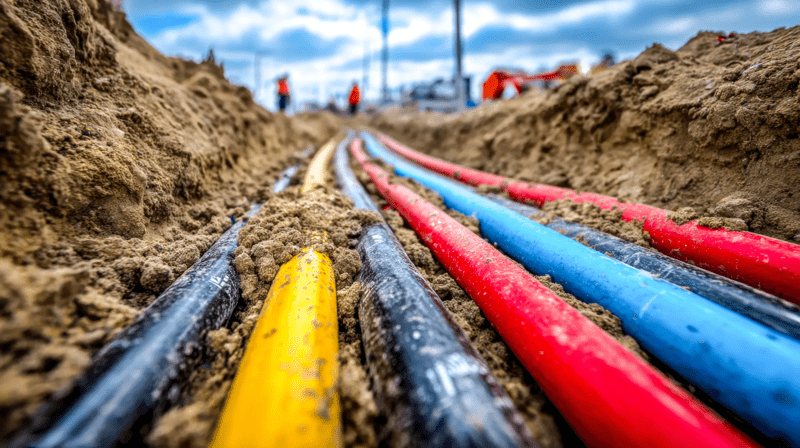
As urban expansion continues across the UK, the infrastructure that powers modern cities is under increasing pressure. Most low-voltage (LV) electricity is distributed through underground cables installed more than 40 years ago. These older cables, especially paper-insulated cables, are prone to degradation. Faults are difficult to locate because standard detection tools do not pinpoint where they occur, making repairs costly and time-consuming. Locating faults often requires road excavation to find the precise problem before work can begin, driving up both cost and disruption.
Challenge
Faced with these challenges, Sentec partnered with a leading solutions provider to design and develop an advanced low-voltage monitoring system. Conventional tools can identify when a problem occurs, but not where, and those that use active signaling are impractical to scale due to cost. Maintenance teams have traditionally relied on tripped fuses, voltage drops or customer outages before physically excavating cables. The goal was predicting where faults were more likely to happen and pinpointing the damaged cable sections within tens of meters without active signals, enabling faster, more targeted and cost-effective maintenance. At the outset, project parameters were undefined. As Riccardo Di Pietro, Technical Director at Sentec, explains: “We were developing a new solution, so our remit was very broad – everything from collecting the raw signals to developing the algorithm.”
Sentec needed to design a system that would monitor all three phases on each feeder separately and capable of detecting transient arcing events, accurately identifying their location, and providing real-time insights to field engineers. Detecting these transient faults demanded high-fidelity signal capture, while translating waveform data into actionable insights required robust modelling and software integration. Sensors also had to be installed in low-voltage substations under strict safety protocols, and the solution needed to be scalable and affordable for large-scale rollout.
Solution
Sentec drew on expertise across physics, electronics, firmware, software, and mechanical engineering. The first step was understanding the problem at its most fundamental level. Sentec’s physics experts developed models simulating how underground feeder cables behave when insulation fails.
Each transient arc triggered waveform recording, supporting development of the bespoke Distance-to-Fault (DtF) algorithm – the core of the system, capable of detecting, characterising and locating transient faults without injecting signals into the line or requiring any detailed knowledge on cable geometry. The electronics team then designed a monitoring unit to capture each transient with high signal fidelity, requiring precision analogue design to preserve waveform integrity so the algorithm could interpret it correctly. Sentec’s mechanical engineers developed monitoring hardware that was easy and safe to install. Conventional sensors require two-handed installation and alignment around live busbars. Sentec developed a bespoke current sensor that was faster to fit, safer to handle, and insensitive to alignment errors. Combining precision with ergonomic design, it allows single-handed installation even when engineers are wearing protective equipment – a crucial innovation for scaling deployment.
In parallel, Sentec’s firmware and data teams ensured field data could be processed, analysed and visualised through an intuitive dashboard designed to make insights accessible to maintenance staff and engineers. By clustering events, identifying patterns and ranking issues by severity, engineers could see which parts of the network were most at risk. “The dashboard allows engineers to dig deeper into what is going on, and understand which sites they need to prioritise,” Riccardo says.
Results
The project delivered a scalable, accurate and affordable fault monitoring system – a cost-effective solution with the potential to transform how underground cable networks are managed and maintained. The system supports continuous monitoring, prioritising locations by severity and likelihood of failure, and locates insulation faults within tens of meters for faster, more effective repairs.
By targeting priority areas, Sentec’s solution delivers significant cost savings while strengthening UK energy security. The approach and results were also reflected in the National Grid ALARM Closedown Report, which validated the system’s performance in field trials. “Instead of reacting to failures in the field, this project built a cost-effective solution to prioritise maintenance interventions and reduce downtime,” Riccardo concludes.
Conclusion
Sentec’s work shows how innovation in sensing and data analytics can contribute to solving long-standing infrastructure challenges. By combining technical expertise with practical engineering, the team created a scalable system that redefines fault detection and supports a smarter, more resilient UK energy future.