

Closing the pinhole-sized gap in your leak detection strategy
Pipeline operators strive to achieve zero incidents, spending millions of dollars every year on integrity programs to safely deliver energy resources. Modern technologies have improved operators’ ability to proactively detect and address threats. However, leaks unfortunately still occur.
Finding a leak quickly helps mitigate the impact of releases on people, property, and the environment. Pipeline operators can detect and locate leaks with high precision using Pure Technologies' SmartBall® platform. Beyond leak detection, the tool can deliver value to operators in a variety of other ways.
In this three-part series, we’ll discuss how SmartBall technology can help pipeline operators find active leaks, confirm containment, and even monitor threats that are keeping you up at night.

Closing the Gap
Regulations in the United States and Canada require pipeline operators to have an integrity program in place to prevent and mitigate risks. There are a variety of tools available to detect threats that could compromise the pipe wall. Common threats include cracks, corrosion, and geometric deformations. Despite proactive efforts, these pipe wall defects can still lead to an active leak.
That is why regulatory bodies also mandate Leak Detection Systems (LDS). While there are a variety of methods available, continuous pipeline monitoring systems are the most commonly used LDS for liquid hydrocarbon pipelines. These systems use data such as pressure, flow, or temperature to infer leaks and alert pipeline operators to a loss of containment.
A robust leak detection program is multi-layered, as it’s impossible for a single LDS to detect all possible leaks.
Most continuous pipeline monitoring systems have a high leak detection threshold — generally around three percent of total pipeline throughput. At this threshold, systems can usually detect larger leaks and ruptures. However, pinhole leaks tend to slip under the radar. This results in a significant product release over time, especially on large-diameter pipelines. Though they are small, pinhole leaks can also lead to pipeline failure and cause serious environmental problems.
A Complementary Approach
Pipeline operators can mitigate gaps in their leak detection program by combining complementary tools that excel in different areas.
Combining SmartBall with continuous leak monitoring enables pipeline operators to detect a broader spectrum of leaks. The tool’s industry leading lower leak detection threshold can locate pinhole leaks as small as 0.03 GPM.
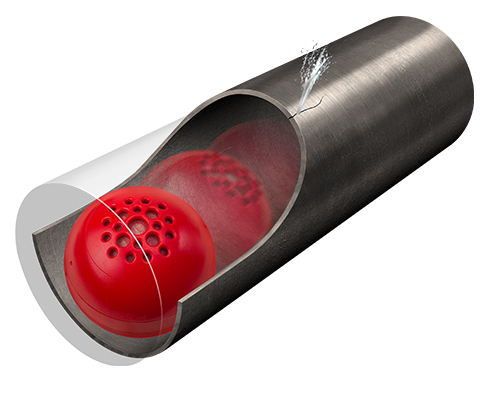
SmartBall can act as a standalone leak detection tool, but it also complements existing continuous monitoring systems to create a best-in-class leak and integrity management program.
The longer leaks go undetected, the greater their impact. Pure Technologies can mobilize within 24 hours in emergency situations. SmartBall licensing is also available so pipeline operators can use the tool as frequently as needed.
Up Next
Stay tuned for the next blog in our series where we’ll discuss how operators use SmartBall to confirm containment and verify that their pipelines are leak free. We’ll explore how you can leverage this approach to help manage existing risks and more efficiently schedule outages and repairs.
Have questions about how SmartBall can help you? Pure Technologies’ extensive leak detection and pipeline monitoring experience gives us valuable insight into the ways that SmartBall can be integrated into ILI and leak detection programs.